
In case of Petroliv Petrolium Vs State of Kerala, Hon’ble Kerala High Court held that uploading a Notice on the common portal amounts to valid service under GST law. Entrusting the matter to a lawyer does not absolve the taxpayer of the duty to track the proceedings, so a writ petition cannot be used to bypass the appellate remedy.
Author: Pushkar Mer
Time limit for passing a penalty Order on detained goods
In case of Siddhi Vinayak Automobiles Vs. Commissioner of Kerala State GST , GSTAT (Thiruvananthapuram) held that The seven-day period prescribed under Section 129(3) of CGST Act for passing a penalty Order after service of the detention Notice is mandatory and not merely directory. A penalty Order passed well beyond that period is without jurisdiction and liable to be set aside.
Accounts Payable – Legal Aspects
Payment outstandings are very common in business. Sometimes businesses are not considering outstandings seriously. However, payment outstandings might lead to many legal complications. ₹1 crore or more is the minimum threshold required to trigger the Corporate Insolvency Resolution Process (CIRP) under Section 4 of the Insolvency and Bankruptcy Code (IBC).
For operational debts, the claim must be undisputed, and a proper demand notice must be served with no valid payment or dispute raised by the corporate debtor.
Not responding to an outstanding default of ₹1 crore easily breaches the minimum threshold under Section 4 of the IBC, allowing the aggrieved creditor to file a direct application at the National Company Law Tribunal (NCLT) to trigger the Corporate Insolvency Resolution Process (CIRP).
Operational creditors having outstanding 1 crore or more (individually) should not ignore follow up communications from debtors and must raise letter of dispute mentioning reasons of not releasing payments.
Denial of ITC on cancellation of a supplier’s registration
The Supreme Court refused to interfere where the High Court had held that once actual movement of goods and payment of tax are proved by the purchasing dealer, proceedings alleging fraud or suppression are not justified merely because the supplier’s registration was later cancelled. This is a major taxpayer-friendly ruling that protects honest buyers.
Safecon Lifesciences Pvt Ltd (Supreme Court of India)
Limitation period for issuance of Order
In the landmark case of M.M. Motors v. Senior Joint Commissioner of Revenue Hon’ble Calcutta High Court held that limitation relates to the act of issuance, meaning the digital signing of the Order, and not to its subsequent service on the taxpayer. An Order digitally signed within the limitation period remains valid even though it was uploaded on the portal after the deadline.
GRN Reporting Requirement
As part of the Reserve Bank of India’s updated framework under the Foreign Exchange Management (Guarantees) Regulations, 2026, dated January 06, 2026, new reporting obligations have been introduced for all guarantees involving cross‑border parties. These requirements are effective from Quarter ended March 2026
Who Must Report?
1. Surety / Guarantor (Resident in India)
If you as a resident entity are providing the guarantee.
Example: A resident corporate issuing a guarantee in favor of an overseas entity.
2. Principal Debtor / Applicant (Resident in India)
If you (Principal Debtor) have arranged a guarantee wherein the surety is a non-resident.
Example: A guarantee issued by an overseas parent or bank for credit facilities availed in India.
3. Creditor / Beneficiary (Resident in India)
If both the surety and principal debtor are non-residents, or if you have arranged the guarantee.
Example: Receipt of a guarantee from a foreign bank for obligations of an overseas entity.
Who Must Report?
1. Surety / Guarantor (Resident in India)
If you as a resident entity are providing the guarantee.
Example: A resident corporate issuing a guarantee in favor of an overseas entity.
2. Principal Debtor / Applicant (Resident in India)
If you (Principal Debtor) have arranged a guarantee wherein the surety is a non-resident.
Example: A guarantee issued by an overseas parent or bank for credit facilities availed in India.
3. Creditor / Beneficiary (Resident in India)
If both the surety and principal debtor are non-residents, or if you have arranged the guarantee.
Example: Receipt of a guarantee from a foreign bank for obligations of an overseas entity.
Late Submission Fee (LSF)
The LSF will be calculated as follows:
LSF = ₹7,500 + (0.025% × A × n)
Where:
- A = Amount involved in the delayed reporting (INR)
- n = Number of years of delay (rounded up to the nearest month, expressed up to two decimal places)
Disclaimer: This is just for information, for more details please discuss with your AD.
Amendments to the Guidelines for Trade Regulations, Accreditation and Compliance Enablement under Export Promotion Mission (EPM) – Niryat Disha
In continuation of Trade Notice No. 26/2025-26 dated 20th February 2026, the DGFT has issued a new Trade Notice No. 09/2026-27 dated 1st July 2026 containing amendments to the Guidelines for Trade Regulations, Accreditation and Compliance Enablement under Export Promotion Mission (EPM) – Niryat Disha.
The above notice is linked below for reference:
https://upload.eepcindia.com/eepc-download/eepc_files_03072026_072938.pdf
Government Notifies 31 July 2026 as Extended Due Date for Filing GSTAT Appeals and Applications under CGST Act
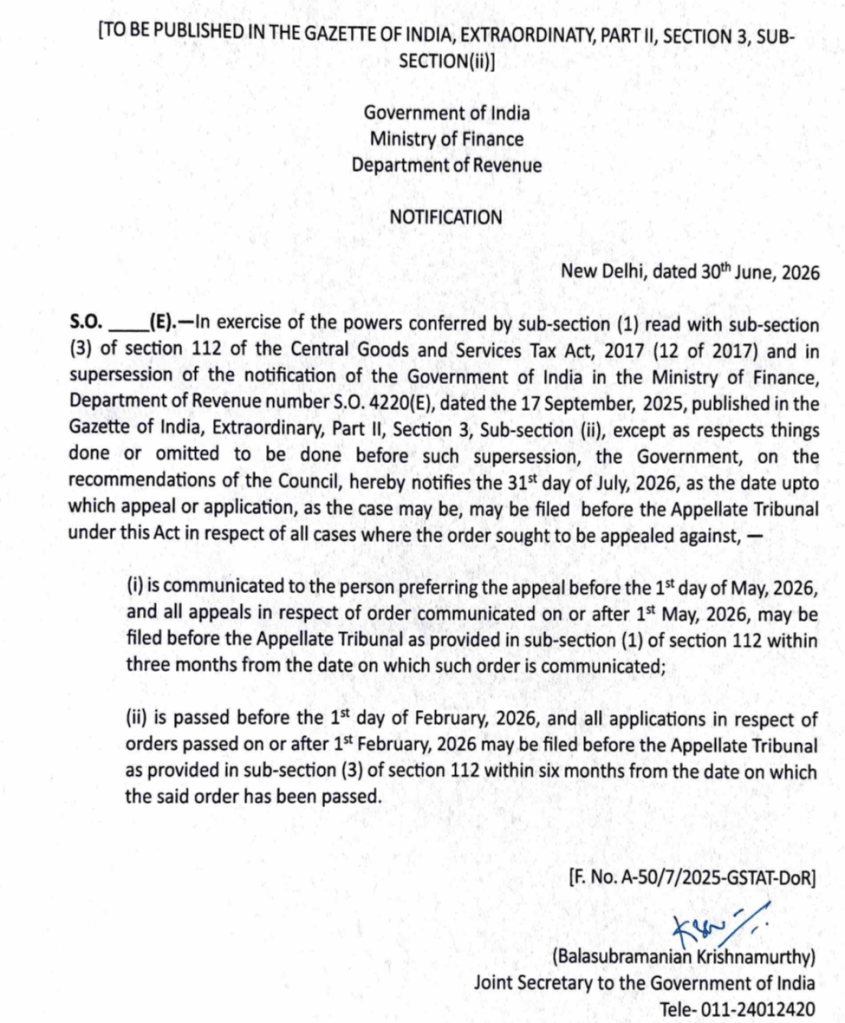
Representation seeking extension of the last date for filing appeal before GSTAT
The Goods and Services Tax Appellate Tribunal (GSTAT) is a creature of statute and is strictly bound by the timelines mandated under the Central Goods and Services Tax (CGST) Act. It possesses no inherent or equitable power to entertain an appeal filed beyond the absolute outer limit allowed by law. A discretionary delay of up to an additional 3 months can be condoned by the Tribunal if sufficient cause is demonstrated.
Tax professionals, industry bodies and bar association urge Finance Ministry to extend June 30 cut-off, citing technical issues on GSTAT portal.
GSTAT portal had been launched by the Hon’ble Finance Minister on September 24, 2025. An Order F. No. GSTAT/Pr. Bench/Portal/125/25-26 dated 24.09.2025 was issued to direct a staggered mode of filing appeals before GSTAT in order to avoid any portal related glitches.
The time-limit for filing appeal for orders is released on the basis of date of order uploaded on the GST portal was set as per the following manner:
| S. No. | Appeals (APL-01/ APL-03) filed on the GST Portal by Assessee or Department or Revisions (RVN-01) issued on the GST portal | Period during which appeal in GST Form APL-05 may be filed |
| 1. | Order issued on or before 31.01.2022 | Appeal could be filed from 24.09.2025 to 31.10.2025 The last date of filing appeal continues to be 30.06.2026 |
| 2. | Order issued on or after 01.02.2022 but on or before 28.02.2023 | Appeal could be filed from 01.11.2025 to 30.11.2025 The last date of filing appeal continues to be 30.06.2026 |
| 3. | Order issued on or after 01.03.2023 but on or before 31.01.2024 | Appeal could be filed from 01.12.2025 to 31.12.2025 The last date of filing appeal continues to be 30.06.2026 |
| 4. | Order issued on or after 01.02.2024 but on or before 31.05.2024 | Appeal could be filed from 01.01.2026 to 31.01.2026 The last date of filing appeal continues to be 30.06.2026 |
| 5. | Order issued on or after 01.06.2024 but on or before 31.03.2026 | Appeal can be filed from 01.02.2026 to 30.06.2026 The last date of filing appeal continues to be 30.06.2026 |
| 6. | Order issued on or before 31.03.2026 | Appeal can be filed from 01.03.2026 upto 30.06.2026 The last date of filing appeal continues to be 30.06.2026 |
Mandatory migration to .bank.in
The RBI circular dated April 22, 2025, mandated that all scheduled commercial and cooperative banks migrate to the .bank.in domain by October 31, 2025. However, this is not a sudden shift, many banks began operations, phased integrations, and user-awareness campaigns running into 2026 to ensure a completely seamless and secure transition without disrupting access.
The .bank.in domain is managed by the Institute for Development and Research in Banking Technology (IDRBT) and strictly implements advanced security protocols, including DNSSEC and high-assurance certificates.
What remains unchanged?
- No change in website content or services
- No change in customer’s user ID, password, or login process
- No change to any existing banking arrangements
This is a great initiative by Reserve Bank of India to reduce digital frauds and to make banking websites more secure & easily recognisable for customers.

