
China reported a record trade surplus of nearly $1.2 trillion in 2025, led by booming exports to non-US markets as producers looked to build global scale to fend off sustained pressure from the US. A push by policymakers for Chinese firms to diversify beyond the world’s top consumer market by shifting focus to Southeast Asia, Africa and Latin America paid dividends, cushioning the economy against US tariffs and geopolitical frictions.
Author: Pushkar Mer
Revised DIR-3 KYC Norms
The Ministry of Corporate Affairs (MCA) has notified a significant compliance relief for all the DIN Holders by amending existing DIR-3 KYC requirements under the Companies Act, 2013 vide its notification dated December 31, 2025. The amendment of Rule 12A of the Companies (Appointment and Qualification of Directors) Amendment Rules, 2025, will come into effect from March 31, 2026.
Key Highlights of the Amendment
1. TRIENNIAL FILING
· Earlier, every DIN holder was required to file DIR-3 KYC annually, even if no changes occurred. Under the revised framework, DIR-3 KYC will now be filed once every three consecutive financial years.
· The form must be submitted on or before June 30 following the completion of the three years, provided the DIN remains valid.
2. SINGLE WEB-BASED FILING SYSTEM
The MCA has streamlined the process by mandating DIR-3 KYC Web as the only mode of filing, removing the earlier distinction between e-forms and web-based filings.
3. MANDATORY UPDATES ON CHANGE IN PERSONAL DETAILS
Despite reduced filing frequency, directors must update their details within 30 days of any change in:
- Mobile number
- Email address
- Residential address
Such updates must be digitally signed by the director and certified by a practising CS, CA or CMA.
4. TRANSITIONAL PROVISIONS
- Directors who completed DIR-3 KYC before April 1, 2026, will automatically move to the triennial cycle.
Example: If DIR-3 KYC was last filed in 2025, the next filing will be due by June 30, 2028.
- Those DIN holders who have not filed their KYC yet may reactivate their DIN by filing under the existing framework up to March 31, 2026.
Ministry of Labour & Employment has notified the draft rules for 4 Labour Codes
After implementation of 4 Labour Codes effective from 21st November 2025, the Central Government has *notified the Draft Rules for each 4 Labour Codes on 30th December 2025* for public comments. Stakeholders have been invited to submit objections and suggestions within 45 days (30 days for Industrial Relations Code).
Please click on below link to access these 4 Draft Rules for Code on Wages, Social Security Code, Industrial Relation Code and Safety, Health and Working Condition Code
https://labour.gov.in/en/labour-codes
How to generate RoDTEP Scrips
The RoDTEP (Remission of Duties and Taxes on Exported Products) scheme is an Indian government initiative launched January 1, 2021, to boost exports by refunding hidden, non-refundable central, state, and local taxes/duties incurred during the manufacturing and distribution of exported goods, making Indian products more globally competitive.
To avail benefits of RoDTEP, the exporter must make a specific declaration in the shipping bill at the time of export.
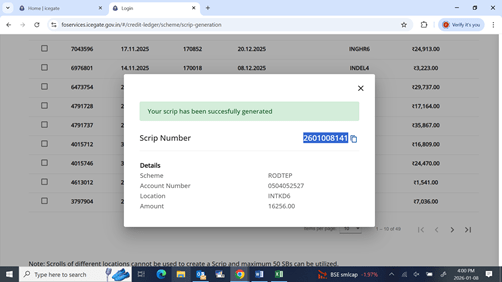
To generate e-scrips following easy steps needs to be followed:-
Login to Icegate
Click on eScrip-Credit Ledger
Click on View Complete Details
Scrip generation
Enter port code in search location menu and click on search
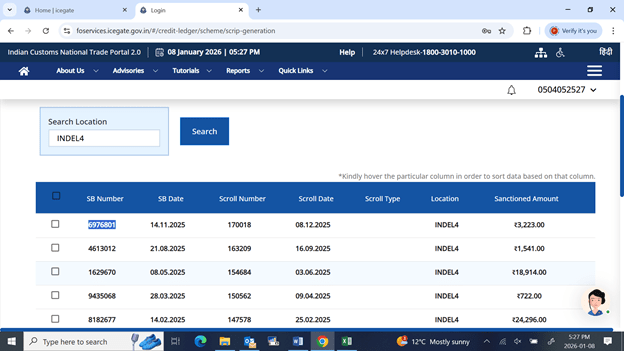
Click on check box and then click Create Scrip
Gross Direct Tax Collection increased by 4.16%
Gross Direct Tax collection for FY 2025-26 (upto 17 December 2025) is Rs 20.02 lakh crore, 4.16% higher than gross collection for corresponding period last year
CBDT has released the following statistics: –
| For the period 1 April 2025 till 17 December 2025 | Amount (Rs.) | Remarks |
| Gross direct tax collection | Rs 20.02 lakh crore | 4.16% higher than gross collection for corresponding period last year |
| Net direct tax collection (after adjustment of refunds) | Rs 17.04 lakh crore | 8.00% higher than net collection for corresponding period last year |
| Refunds issued | Rs 2.97 lakh crore | 13.52 % lower than refunds issued for corresponding period last year |
| Advance Tax | Rs 7.88 lakh crore | 4.27% higher than refunds issued for corresponding period last year |
Place of supply of goods
In case of Toyota Kirloskar Motor Pvt Ltd Vs Union of India, hon’ble Karnataka High court ruled that place of supply (PoS) of goods shall be the place where movement of goods terminates for delivery to recipient and not the place from where movement of goods originates.
Pre-deposit for filing appeal
In case of Vaneeta Impex Private Limited v. Union of India & Ors., Hon’ble Delhi High Court held that Demand raised under CGST and SGST on same issue; pre-deposit cannot be demanded separately for filing appeal under CGST & SGST.
Survey on Foreign Collaboration in Indian Industry: 2023–2025 – Data Release
Reserve Bank released the results of the fifteenth round of its biennial survey on foreign collaboration in Indian industry (FCS) covering the financial years 2023-24 and 2024-25. This survey captures information on financial parameters and operations of the Indian companies having technical collaboration with foreign companies.
Highlights:
- Foreign technical collaboration (FTC) agreements were primarily present in the foreign direct investment (FDI) companies, which were either foreign subsidiaries (i.e., single foreign investor holding more than 50 per cent of total equity) or foreign associate companies (i.e., foreign investors’ equity holding ranging between 10 to 50 per cent), with 68 per cent and 21 per cent share of the total FTCs, respectively.
- The FTCs in the manufacturing sector entities accounted for 78.4 per cent of the total reported FTCs, of which, machinery and motor vehicles together accounted for 30.6 per cent; while FTCs in the services sector constituted 16.6 per cent.
- Japan, the United States of America (USA) and Germany remained the top three countries contributing to the technical collaborations in the Indian entities.
- Around 61 per cent of FTCs involved technology know-how transfer by the foreign collaborators and 8 per cent FTCs were for use of trademarks / brand names.
- Royalty payments, inclusive both royalty and lump sum technical fees, was the payment mode for around two-thirds of FTCs.
- Of the 601 reported FTC agreements, 187 had export restriction clauses and 188 FTC had provision for exclusive rights on assets transferred.
- Manufacturing sector had the highest share in value of production among the FTC companies. Within manufacturing, motor vehicles sector had the largest share.
- The exports of the FTC reporting entities grew at a faster pace (20.3 per cent) as compared to the imports (4.6 per cent) in 2024-25 – they had 17.7 per cent and 18.6 per cent shares, respectively, in the total value of production.
- Average profitability of FTC reporting companies, measured by the ratio of gross profit to capital employed, stood at 14.4 per cent in the current survey round.
Great initiative by Government of India towards simplification of labour laws
The Government has consolidated 29 labour laws into four comprehensive Labour Codes. The four Labour Codes include the Code on Wages, 2019, the Industrial Relations Code, 2020, the Code on Social Security, 2020 and the Occupational Safety, Health and Working Conditions Code, 2020.
The Industrial Relations Code, 2020
The Industrial Relations Code, 2020 revolutionizes labour laws by simplifying compliance and promoting harmonious employer and employee relations. It strengthens collective bargaining, dispute resolution, and job security through clearer, uniform provisions. The Code empowers workers with uniform definitions while granting employers greater flexibility in operations. Overall, it fosters industrial peace, boosts productivity, and supports a balanced, growth-oriented work environment.
The Code on Wages, 2019
The Code on Wages, 2019 promotes fairness, equity, and inclusivity in India’s labour market. By ensuring uniform wage standards and social security, it safeguards both workers’ rights and employers’ interests. Overall, it strengthens economic justice, encourages formalisation, and enhances the dignity of labour.
The Code on Social Security, 2020
The Code on Social Security, 2020 consolidates nine existing labour laws into a single, comprehensive framework. It is a step to ensure universal social protection for all workers by strengthening social welfare coverage for both organized and unorganized workers including gig and platform workers. It also promotes women’s participation in the workforce, and simplifies compliance, thereby enhancing ease of doing business.
The Code reflects the Government’s commitment towards inclusive growth and social security for all, in line with the vision of a Viksit Bharat by 2047
The Occupational Safety, Health and Working Conditions Code, 2020
The Occupational Safety, Health and Working Conditions Code, 2020 strengthens India’s labour architecture by unifying standards, empowering workers, and enhancing ease of doing business. It lays the foundation for a safer, fairer, and more productive workforce aligned with India’s vision of inclusive and sustainable growth.
Supreme Court’s landmark GST Ruling
In case of Deputy Commissioner St & Ors Vs Wingtech Mobile Communications (India) Pvt. Ltd. & Anr, hon’ble Supreme Court held that once a taxpayer pays the 10% pre-deposit required for filing an appeal under GST, the department cannot attached bank account or block funds.
Key points
- No bank account attachment after payment 10% pre depoit
- Deemed stay on recovery
- Protects genuine taxpayers from unfair recovery
This landmark decision of hon’ble Supreme Court is a big relief to corporates.

